
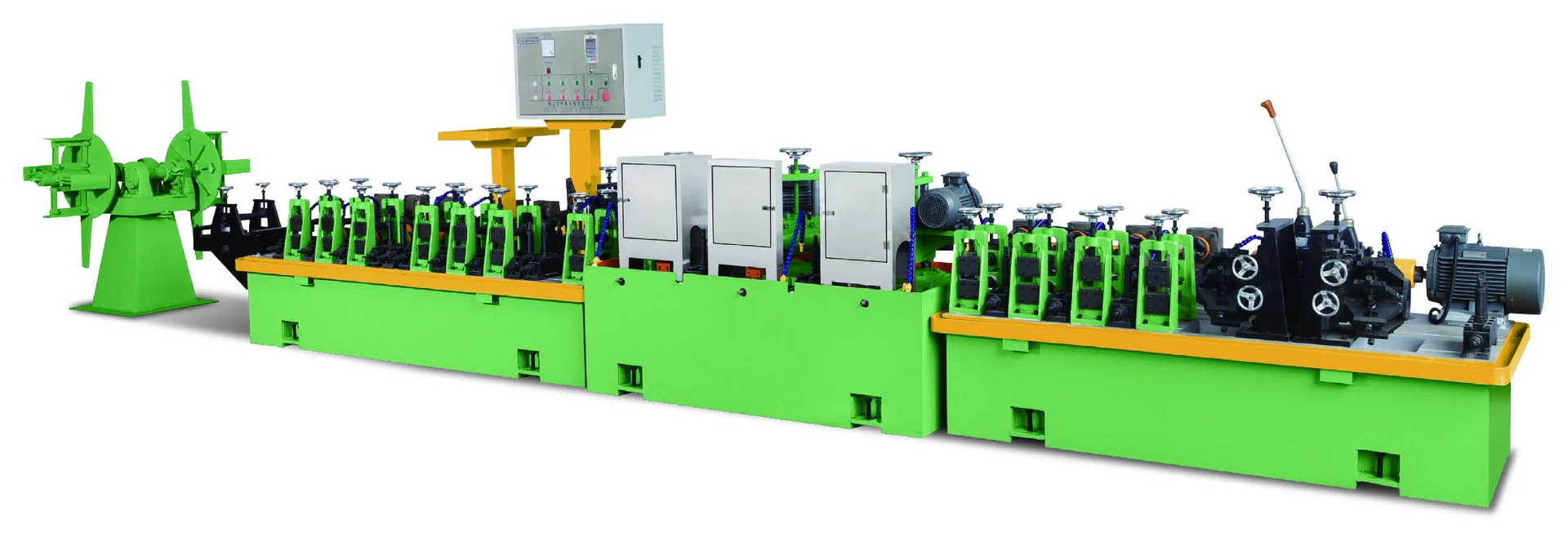
The word “tube equipment” can describe several different operations. A Standard Tube Mill makes welded tube from metal strip. External polishing works on the outside of an existing tube or pipe. Internal polishing works on the inside wall. Coil slitting and cut-to-length produce different outputs from metal coil. Selecting the process first prevents the rest of the inquiry from using the wrong parameters.
This framework turns an unclear equipment request into a sequence of questions that can be checked against the current MAXDO catalog.
Input material and finished output
Begin with one sentence: “We start with ___ and need to produce ___.” Use the following process map:
| Input and required output | Equipment path |
|---|---|
| Metal strip into welded tube | Standard Tube Mill |
| Existing round tube with an outside finish | Round Tube Polishing |
| Existing industrial round pipe with an outside finish | Industrial Round Pipe Polishing |
| Existing square tube with selected faces finished | Square Tube Polishing |
| Existing pipe with an inside wall finished | Internal Pipe Polishing |
| Wide coil into narrower strips | Coil Slitting |
| Wide coil into sheets of a defined length | Cut-to-Length |
The output determines the first product family. Do not begin with a broad industry label when the operation itself gives a more precise starting point.
Tube production and tube polishing
A tube mill starts with strip and creates welded tube. Polishing equipment starts with tube or pipe that already exists. These operations require different input information.
| Operation | First fit information |
|---|---|
| Welded-tube production | Tube outside diameter, wall thickness, shape, strip and production requirement |
| Outside polishing | Tube or pipe type, diameter, wall thickness, length, current surface and target finish |
| Inside polishing | Listed pipe diameter, polishing length, generation/model, current inside surface and target finish |
| Square-tube polishing | Width, height, wall thickness, length and faces to polish |
| Coil processing | Material, coil size and required strip or sheet output |
Outside, inside or square-tube polishing
“Polishing” is not enough to identify the machine. State whether the process works on the outside surface, the inside wall or selected square-tube faces. The current catalog treats outside and inside polishing as separate product families.
The distinction matters because the model tables use different fields. External round-tube and industrial-pipe tables emphasize diameter, wall thickness, supports, motors and machine dimensions. Internal tables add generation, polishing length, stations and spindle speed.
Dimensions for each equipment process
Use the dimensions that match the selected process:
- Tube mill: outside diameter and wall thickness.
- Round or industrial pipe polishing: diameter, wall thickness and length.
- Internal polishing: listed pipe diameter, polishing length and wall thickness when available.
- Square tube polishing: width, height, wall thickness, length and polished faces.
- Coil processing: coil width, thickness, weight and the required strip or sheet dimensions.
The current square-tube and coil records do not include complete public numerical model tables. The correct article-level guidance is therefore to identify the needed fields without inventing model limits.
Tube mill range example: 25–60 mm and 76 mm
Assume a factory needs welded tube in a regular range of 25–60 mm outside diameter and 0.8–2.0 mm wall thickness, with a possible future size of 76 mm.
- MD-40L covers 12–64 mm and 0.3–2.0 mm, so it covers the regular range but not the future 76 mm size.
- MD-50 covers 25–76 mm and 0.3–2.0 mm, so it covers both the regular and stated future range.
- MD-60 covers 50–114 mm and 0.3–2.5 mm, so it also covers the range but starts above the regular 25 mm minimum.
This example does not make MD-50 an automatic final choice. It shows how the regular range, future range and wall thickness work together before factory layout and configuration are reviewed.
Required tube, pipe or surface result
For tube production, describe the required tube output and production context. For polishing, describe the current surface and the required finish. The local source material uses mirror, matte and brushed finish terms for round-tube polishing, but the public data does not define a complete roughness value or acceptance method for those terms.
Use a sample, drawing or approved measurement definition when the surface result matters. Motor power or motor count alone cannot define the final finish.
Machine footprint and material handling
A machine can pass a dimensional screen and still require a layout review. Check nominal machine dimensions, material loading, finished-product removal, operator position, inspection access, maintenance access and any confirmed auxiliary equipment.
The current data includes model dimensions for tube mills and several polishing families. It does not publish a universal foundation, utility or safety-clearance specification. Treat those items as layout-review questions tied to the selected model.
Equipment inquiry information
A useful first request includes:
- The operation and required output.
- Workpiece or input material.
- Shape and critical dimensions.
- Processing surface or coil output.
- Current surface condition and target finish when relevant.
- Regular and future production range.
- Available floor space and handling direction.
- Drawing, photograph or sample when it explains the requirement.
MAXDO can discuss equipment selection, sample or drawing evaluation and sample testing. Installation, commissioning, training, maintenance, spare parts and remote troubleshooting are services whose scope, timing and commercial terms are handled per project.
Match process, surface and output
A reliable equipment decision follows a clear order: identify the input and output, separate production from finishing, name the processing surface, record the dimensions, describe the required result, check the factory path and then request technical assessment. The current MAXDO data supports this first-stage process across tube mills, outside polishing, inside polishing, square-tube polishing and coil-processing families without inventing unsupported performance or configuration claims.