
“Pipe polishing” is incomplete as an equipment requirement. The machine may work on the outside surface, the inside wall or selected faces of a square tube. Those surfaces have different access, support and selection questions.
The current MAXDO catalog separates external polishing families from internal pipe polishing. When a project needs both surfaces, describe them as separate process steps until a combined arrangement is technically confirmed.
Outside, inside or square-tube polishing
Use one of these clear descriptions:
| Requirement | Equipment path |
|---|---|
| Finish the outside of round tube | Round Tube Polishing, MA or ME records |
| Finish the outside of industrial round pipe | Industrial Round Pipe Polishing, MG records |
| Finish the inside wall of pipe | Internal Pipe Polishing, generation and model records |
| Finish selected faces of square tube | Square Tube Polishing, drawing-led selection |
| Finish both outside and inside surfaces | Separate outside and inside process descriptions |
This first distinction prevents a common error: using an external polishing range to answer an internal-wall question or assuming that the word “polishing” identifies one machine family.
Outside polishing for round tube and industrial pipe
For round-tube and industrial-pipe polishing, record outside diameter, wall thickness, length, current surface, target finish, feeding method and support method.
The current numerical boundaries are:
- MA and ME round-tube records: 12–63 mm and 51–129 mm diameter ranges, with 0.3–2.5 mm listed wall thickness.
- MG industrial-pipe records: 6–51 mm through 114–426 mm by model, with 1.5–10 mm listed wall thickness.
- Square-tube records: structure, polishing-head and guide drawings without a matching public model table.
The outside process should be described in terms of the surface the heads can reach and the way the workpiece is guided through the machine.
100 mm pipe cross-family screening
Suppose a project describes a 100 mm pipe with a 5 mm wall and a 4.5 m processing length. Use the same workpiece description to create two separate screens:
| Process step | Candidate screen | What the table shows |
|---|---|---|
| Outside polishing | MG-114 | 15–114 mm diameter and 1.5–10 mm wall thickness include the example size |
| Inside polishing | Third-generation MD133 | φ63–φ133 diameter and 1–6.1 m polishing length include the example |
| Inside polishing | Fifth-generation MD133 | φ63–φ133 diameter and 4–6.1 m polishing length include the example |
The arithmetic narrows the outside and inside candidates separately. It does not mean that MG-114 and either internal MD133 row form a confirmed combined line. The project still needs a process-order, handling and finish review for the two steps.
Inside-wall polishing and tool access
Internal polishing requires the tool path to reach the inside wall. The current internal records are organized by generation and model, with fields for listed pipe diameter range, polishing length, stations, spindle speed and machine dimensions.
A request for internal polishing should therefore include:
- the pipe diameter as used in the relevant table;
- required polishing length;
- wall thickness when available;
- current inside-surface condition;
- required finish or acceptance sample;
- pipe length and handling arrangement;
- generation and model if already known.
The current public data does not define one universal roughness value or acceptance method. A table can narrow the candidate; a sample or approved measurement method defines the result.
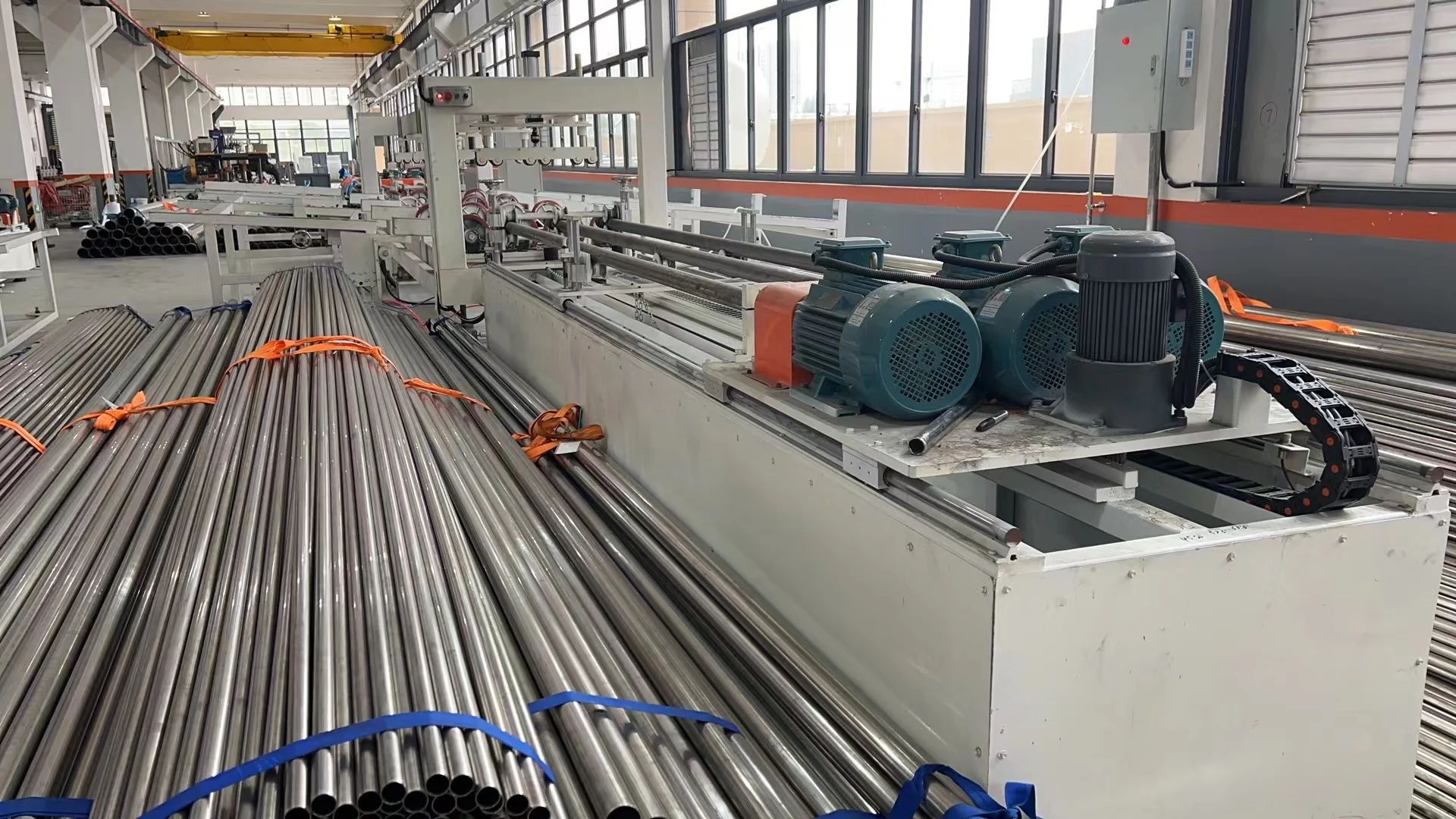
MAXDO internal pipe polishing equipment and pipe handling area shown in the local site photograph.
Outside and inside polishing sequence
Suppose an existing round pipe needs an outside finish and an inside-wall finish. Write the requirement as two linked steps:
- Outside polishing: identify the round-tube or industrial-pipe family, diameter, wall thickness, length, surface and support method.
- Inside polishing: identify the internal family, listed diameter, polishing length, generation/model context and inside-surface requirement.
- Define the order of operations using the actual material flow and inspection method.
- Confirm whether the project uses separate machines, staged processing or another arrangement.
The current catalog confirms the outside and inside families as separate product paths. It does not publish a universal combined machine or one-pass arrangement. Treat the two paths separately until the project review confirms otherwise.
Loading, support and finished-product removal
The process boundary is also a material-flow boundary. Ask:
- Can the pipe be supported without damaging the finished surface?
- Does the first process change the surface condition used by the second process?
- Where will inspection occur between the two steps?
- How will the pipe be turned, transferred or stored?
- Which machine dimensions and operator positions must fit the same factory area?
These questions connect the surface decision to installation and quality control without inventing a combined configuration.
Outside-and-inside polishing request
A useful request can say:
We need outside polishing for a round pipe and separate inside-wall polishing for the same pipe. The outside process must be evaluated from the pipe diameter, wall thickness, length, current outside surface and target finish. The inside process must be evaluated from the listed pipe diameter, polishing length, current inside condition and target finish. Please review the process order, machine families, handling path and sample requirement as one project.
This wording keeps the shared workpiece visible while preserving the equipment boundary.
Separate outside and inside polishing steps
Define the processing surface before selecting a product family. Outside polishing and inside polishing use different access conditions and different comparison fields. When both surfaces matter, describe the operations separately, connect them through the material flow and request a confirmed process arrangement for the specific project.